Relationship Rebuild & Communication Support
Service Type(s):
- Couples Counselling
- Communication Coaching
- Conflict Resolution Support
Service(s) Delivered:
- Joint Intake Session + Individual Check-ins (as needed)
- 8-Session Couples Program
- Communication Frameworks & Take-Home Exercises
This case involves a woman in her late 40s who sought therapy due to persistent health-related anxiety. She frequently worried that minor bodily sensations, such as a headache, muscle tension, or a brief racing heartbeat, signalled a serious medical condition. Despite regular medical check-ups confirming her physical health, she found herself trapped in cycles of catastrophic thinking, often spending hours researching symptoms online, seeking reassurance, and imagining worst-case scenarios. This anxiety disrupted her sleep, concentration, and daily routines, leaving her exhausted and distressed.
In the initial sessions, we explored the origins of her anxiety. She described growing up in a family where health concerns were frequently amplified, and illness often triggered heightened fear and worry. Over time, she developed a belief that she must remain hypervigilant about her body to avoid danger. Small sensations were automatically interpreted as signs of serious illness, reinforcing a feedback loop of anxiety, rumination, and avoidance.
CBT therapy began with identifying cognitive distortions that maintained her anxiety. She exhibited patterns of “catastrophising” (“If my chest feels tight, it must be a heart attack”), “fortune-telling” (“I just know something terrible is going to happen”), and “selective attention” (focusing exclusively on symptoms while ignoring reassurance or normal health indicators). We used thought records and guided questioning to help her unravel these patterns, examining evidence for and against her assumptions and evaluating the likelihood and impact of feared outcomes.
Behavioural experiments were introduced to test the validity of catastrophic predictions. For example, she was encouraged to delay seeking reassurance after noticing a symptom or to engage in normal daily activities despite experiencing bodily sensations. After each experiment, we reviewed her experiences, noting instances where the feared outcome did not occur and reinforcing evidence-based, balanced thinking.
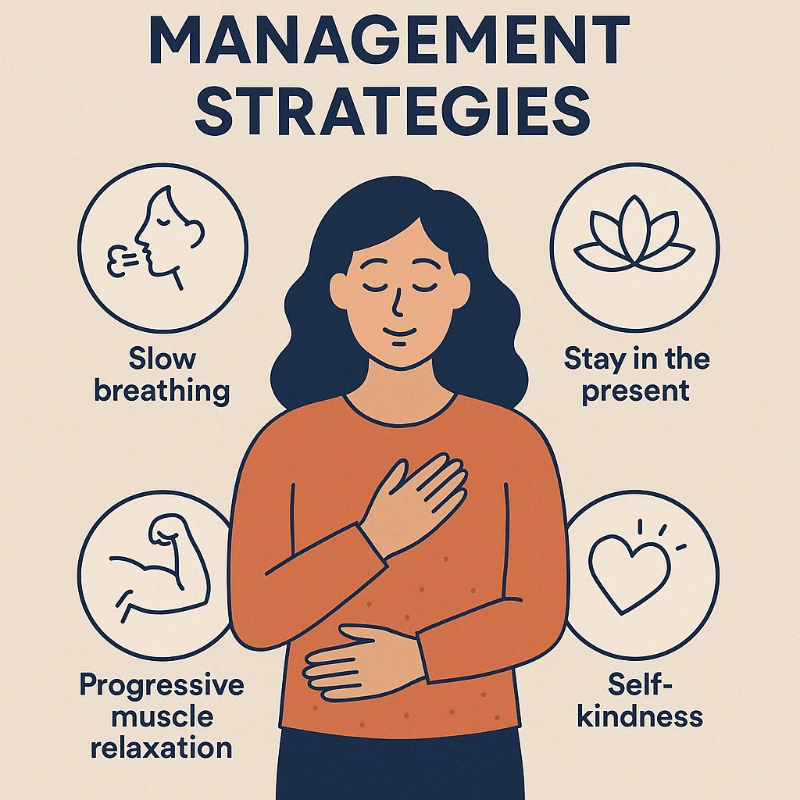
A key component of therapy was cognitive restructuring, or “cleaning up twisted thinking.” She learned to challenge automatic catastrophic thoughts and replace them with more realistic interpretations. For instance, a racing heartbeat was reframed as a normal physiological response to stress or activity rather than a sign of impending cardiac failure. These techniques helped her regain a sense of control over her thoughts and reduce the intensity of anticipatory anxiety. Alongside cognitive work, stress regulation strategies were integrated to address the physical manifestations of anxiety. Over time, she became more grounded in the present, without being overwhelmed by fear.
Over several months, she reported a significant reduction in both the frequency and intensity of health-related worries. She felt more confident in interpreting bodily sensations realistically, less reliant on reassurance-seeking, and able to engage in normal daily routines without anxiety interference. At the end of therapy, she described feeling a greater sense of mastery over her thoughts and emotions. She could observe bodily sensations without triggering catastrophic predictions, approach potential health concerns calmly, and maintain balanced thinking even in uncertain situations.
This case illustrates how Cognitive Behavioural Therapy can provide tools to identify, challenge, and restructure distorted thoughts, with health-related anxiety, while reinforcing resilience, self-efficacy, and emotional regulation. Through cognitive restructuring and stress-regulation techniques, clients can reduce anxiety, regain confidence in their ability to cope, and restore balance to both mind and body.