Relationship Rebuild & Communication Support
Service Type(s):
- Couples Counselling
- Communication Coaching
- Conflict Resolution Support
Service(s) Delivered:
- Joint Intake Session + Individual Check-ins (as needed)
- 8-Session Couples Program
- Communication Frameworks & Take-Home Exercises
This case involves a man in his early 60s who sought therapy after the breakdown of a long-term marriage. His wife had recently left him, expressing that she had fallen out of love, leaving him to navigate the challenges of divorce, asset division, and sudden loneliness. Most of his adult children lived interstate, and he reported feeling increasingly isolated. Alongside the emotional upheaval, he faced underlying health concerns, which amplified fears about the future, his mortality, and the possibility of having no one to rely on as he aged.
In his initial sessions, he described persistent anticipatory anxiety. He worried about being alone, experiencing illness without support, or encountering unforeseen crises. This fear manifested as tension, difficulty sleeping, racing thoughts, and restlessness. Although he had been independent and self-sufficient for much of his life, the recent life changes had triggered a sense of vulnerability and a perceived loss of safety.
Therapy began by creating a supportive and containing space where he could explore these fears without judgment. Through discussion, we traced his anxiety patterns to both the immediate stress of divorce and deeper experiences of insecurity and abandonment from earlier life events. He became aware of how anticipatory anxiety had shaped his behaviour, leading him to over-plan, ruminate, and withdraw from social contact, in an attempt to pre-empt potential loss or harm.
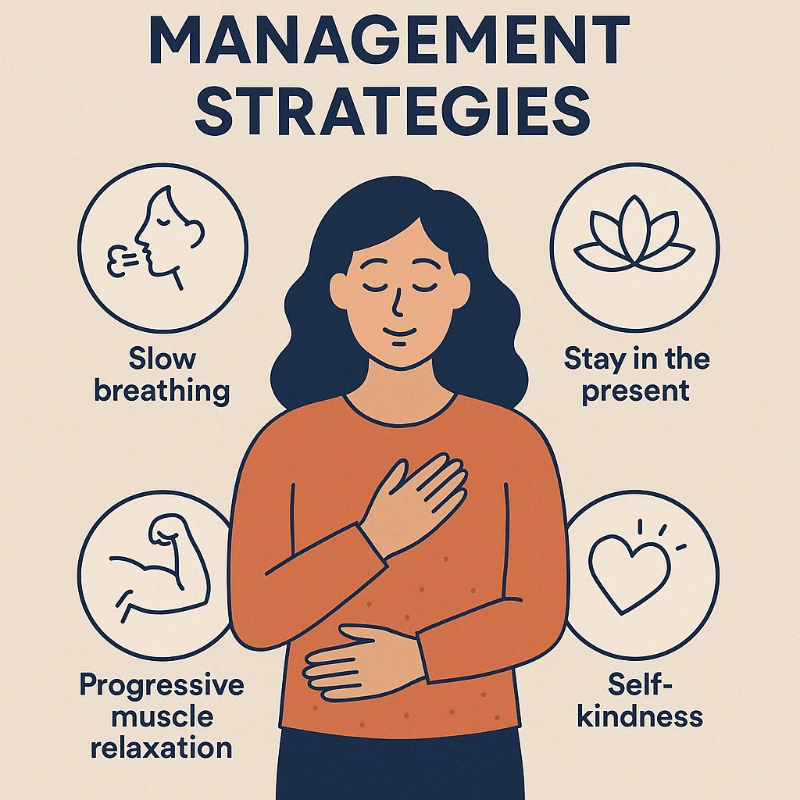
A central focus of therapy was regulating his nervous system and reconnecting with the present moment. Using grounding exercises, breathwork, and body-based awareness, he learned to notice when his body was responding to imagined future threats and to shift back into a state of calm. He described a history of “living in his head,” constantly projecting into the future, which had left him disconnected from his body and the present.
Alongside Somatic Psychotherapy, we examined the beliefs driving his fear, such as “I will be alone and unsupported” or “I cannot cope if something happens to me.” Through guided dialogue and reflective exercises, he learned to challenge these assumptions and consider alternative perspectives, such as the resources and connections he still had, and his capacity to care for himself. He practised reaching out to friends and extended family, seeking support, and attending community events despite initial discomfort. He also developed strategies for coping with moments of acute worry, including mindful observation of thoughts, anchoring in the present, and pacing self-care routines.
Over time, he reported a reduction in intrusive fears about the future and wasn’t entertaining catastrophic thinking as much as before therapy. He felt more able to tolerate uncertainty and became increasingly engaged in social and community life. By the conclusion of therapy, he described feeling more grounded, resilient, and capable of navigating life’s uncertainties. While he acknowledged that future challenges would arise, he had developed tools to manage anticipatory anxiety, a stronger sense of self-reliance, and the confidence to engage with others meaningfully.
This case illustrates how Anxiety Counselling can support clients facing life transitions and anticipatory fears. By combining somatic regulation, cognitive restructuring, and relational exploration, clients can learn to tolerate uncertainty, reduce future-focused anxiety, and reconnect with the present, fostering emotional balance, resilience, and renewed confidence in themselves and their lives.