People search for the 7 stages of grief because they want to know whether what is happening to them is normal. That is the real question underneath, and the answer is almost always yes.
We are Richard and Helena Boyd, and across 21 years from our rooms in Inglewood we have sat with a great many people after a death. The stages are a useful vocabulary and a poor map. This explains what each one means, where the model came from, what the research found when someone tested it, and when grief needs more than time.
What Do The 7 Stages Of Grief Mean?
The seven stages describe common emotional responses after a loss. They are not a checklist and not a diagnosis.
Used well, the stage model does one thing very effectively, which is to give people language for feelings they cannot organise. When you can name numbed disbelief or say the word bargaining, an experience that felt like going mad has a shape. That is worth a great deal at three in the morning.
Used badly, it becomes a scorecard. There is no right or wrong way to grieve and no particular order you are supposed to follow.
The 7 Stages In Plain Language
Treat these as signposts rather than steps. Stages overlap and repeat, and several emotions run at once.
Shock
The initial reaction is often not feeling at all. Numbness, mental fog, autopilot. People still set two cups out, or drive toward a hospital that no longer matters. A tight chest, shaky hands and broken sleep are common.
Denial
A protective pause rather than a mistake. Clothes stay where they were. You speak about your loved one in the present tense. Denial buys the nervous system time before it takes on the full reality.
Anger
Anger arrives at doctors, at systems, at the person who died, at yourself, sometimes at a higher power. It is easier to carry than helplessness, which is usually what sits underneath it.
Bargaining
The bargaining stage is where the mind runs the what ifs. If only we had pushed for the scan. If only the call had come earlier. Bargaining is an attempt to regain control over something that was never controllable.
Depression
Deep sadness, withdrawal, no appetite for anything. This is not the same as clinical depression, though they overlap. Grief comes in waves with gaps between them. Depression is flatter and more constant.
Testing
Sometimes called the upward turn. Small experiments back into daily life. Answering two messages. Eating at the table. Progress here looks unimpressive and is not.
Acceptance
Acceptance is not being over it. It means the loss has a place in your life rather than standing between you and everything else, and warmth and pain can sit in the same moment.
Who Created The 7 Stages Of Grief Model?
There is no single medical source for seven stages, and that is worth knowing.
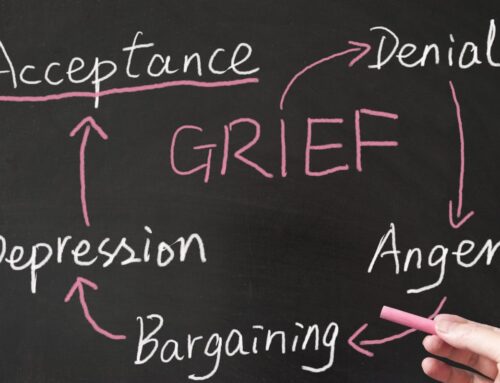
The Kübler Ross model came first. Elisabeth Kübler Ross, a Swiss American psychiatrist, published five stages in 1969 based on her work with terminally ill patients facing their own death. The famous denial anger bargaining depression and acceptance sequence was never about bereavement. It described people who were dying.
Later educators adapted Kübler Ross’s five stages for the bereaved, adding shock at the front and testing near the end. Other versions swap testing for reconstruction and close with hope acceptance and moving forward. Subsequent models multiplied because the additional stages made the list feel more complete, not because new research demanded them.
What The Research Actually Found
One study did test the stage model properly, and the result is more interesting than either side of the argument.
Researchers tracked bereaved people over two years and found the five indicators did peak in the predicted order. Disbelief peaked at one month, yearning at four, anger at five and depression at six.
But two findings undercut the model. Acceptance was the most frequently endorsed response from the very beginning, not a final stage at all. And the dominant negative emotion across the whole two years was not depression or anger. It was yearning, plain missing, which most stage lists do not include.
Are The Stages Experienced In A Linear Way?
No, and expecting that causes real distress.
Grief moves in waves. People circle two stages for months, or touch four in an afternoon. A birthday, a song or a smell can drop you back into week one. Bereaved individuals often tell us they thought they were doing well until something small undid them, leaving them feeling overwhelmed and assuming they have gone backwards.
They have not. That is simply what the grieving process looks like from the inside.
Is The Stage Model Accurate?
Useful with limits is the fair verdict.
The strengths are real. It normalises anger and guilt, gives family members shared language, and makes a sense of mental fog and numbness as ordinary rather than alarming. As a tool for understanding grief, it earns its place.
The limits matter too. It can imply a tidy sequence that nobody experiences, it treats a universal experience as though it were uniform, and it can leave you feeling you are grieving wrongly. Not everyone will recognise all seven grief stages, and skipping some says nothing about you.
The Difference Between The 5 And 7 Stages
The five stages are Kübler Ross’s original list, and the Kubler Ross stages are often written without the umlaut.
Seven stage versions add shock at the beginning, since the first days differ from denial, and testing before acceptance, to capture the tentative return to life. Some lists split pain and guilt into their own stage.
Neither is more correct. Use whichever gives you words for today.
How Long Does Grief Last?
There is no timetable, and anyone offering you one is guessing.
Duration depends on the relationship, whether the death followed a terminal illness or arrived without warning, and what social support you have. Grief symptoms commonly ease over one to two years, with the sharpest change in the first six months.
Rather than asking which stage you are in, watch function. Are you sleeping, eating, moving and speaking to one person. Those four say more about the healing process than any stage model will.
When Grief Becomes Prolonged Grief Disorder
Most people do not need a diagnosis. A minority do, and the criteria now exist.
Prolonged grief disorder, previously called complicated grief, entered the Diagnostic and Statistical Manual of Mental Disorders in the DSM-5-TR in March 2022. For adults the death must have occurred at least twelve months ago, six months for children and adolescents, with intense yearning nearly every day for at least the past month, plus symptoms such as identity disruption, emotional numbness, avoidance of reminders or feeling that life is meaningless.
An estimated 4 to 15 per cent of bereaved adults experience it. If that sounds like you, prolonged grief responds to treatment, and seeking support from a mental health professional is not an admission that you loved someone incorrectly.
Red Flags Worth Raising With A Clinician
Some things should not wait for a stage to pass.
- Persistent inability to work, study or care for yourself
- Relying on alcohol or other drugs to sleep or feel less
- Thoughts that life is not worth living
- Complete isolation, or guilt you cannot shift
- Difficulty accepting the death many months on, with no change over time
Practical Ways To Cope
None of this is a cure and all of it helps, mostly by keeping your body steady enough to feel things.
Protect the basics first. Enough sleep, a balanced diet and daylight do more for emotional well being in early grief than any insight will. Set achievable goals rather than ambitious ones, since one phone call can be a full day’s work.
Use deep breathing when a wave hits, since slowing the out breath settles the body faster than reasoning with yourself. Creative outlets help where words fail, and many people find writing to the person they lost more useful than talking about them. Support groups matter for people dealing with this who feel isolated among friends who have moved on.
How We Work With Grief
Our approach is Integrative Body Mind Psychotherapy, built on the principle that the body is the subconscious mind.
Grief is not a thinking problem, which is why talking about it can leave people no lighter. It sits in the chest, the throat and the gut, and needs somewhere to move. We work with what happens physically as you talk, which is where grief is often held since the funeral, particularly by people who had to be capable for everyone else.
Where a death was sudden or traumatic, Richard’s Sensorimotor Psychotherapy training is the relevant piece, because trauma and grief need untangling before either resolves.
What This Looks Like In Practice
These are composite examples drawn from our clinical work, with identifying details changed.
A man in his sixties came to us fourteen months after his wife died, convinced he had failed at grief because he was angrier than at the funeral. He had spent the first year organising and supporting his children. The anger was not a relapse. It was the first feeling with room to arrive.
A woman in her forties could not stop replaying a decision about her father’s treatment. Working somatically, the bargaining turned out to live as a knot she could locate precisely. The what ifs faded once it had somewhere to go.
A young woman whose mother died suddenly felt nothing at all for months and was frightened by it. Numbness had done its job. The work was not to force feeling but to make the room safe enough for it to return.
Frequently Asked Questions
The questions we are asked most often about grief, and our honest answers.
Do Children Go Through The 7 Stages Of Grief?
Children grieve in behaviour more than words, and in shorter bursts. Young ones show clinginess, irritability or stomach aches. Teenagers swing between independence and sudden closeness. Clear language, steady routines and repeated invitations to talk beat any stage framework.
Is It Normal To Feel Nothing?
Yes. Numbness is a protective coping mechanism and it is very common early on and in later spikes. Feeling usually returns in bursts. If it persists for months alongside declining function, that is worth raising with a professional.
Can You Skip Stages?
Yes. You can skip, repeat or experience several at once and still be grieving healthily. Notice what helps rather than where you sit on a chart.
When Should You Seek Professional Help?
If distress and impairment are not shifting over months, if you have thoughts of not wanting to be here, or if you simply want support. You do not have to meet criteria to deserve help.
Where To Go From Here
The 7 stages of grief give you a vocabulary for something that will feel overwhelming and formless. Use them for that, and put them down when they start feeling like a test you are failing. What the evidence shows is that acceptance is present from the start and that missing someone is the strongest feeling of all, which is not a stage but the whole shape of it.
If grief has stopped moving, or you are carrying it alone, our grief counselling works with adults and families at our Inglewood rooms and online. No referral is needed. If you are in crisis right now, call Lifeline on 13 11 14.
About the Author


Fees And Rebates
We offer cost-effective solutions that can fit within your budget. The insights and skills acquired in therapy can continue to positively impact mental and emotional health long after the therapy sessions have ended, making it a truly worthwhile investment in yourself.